
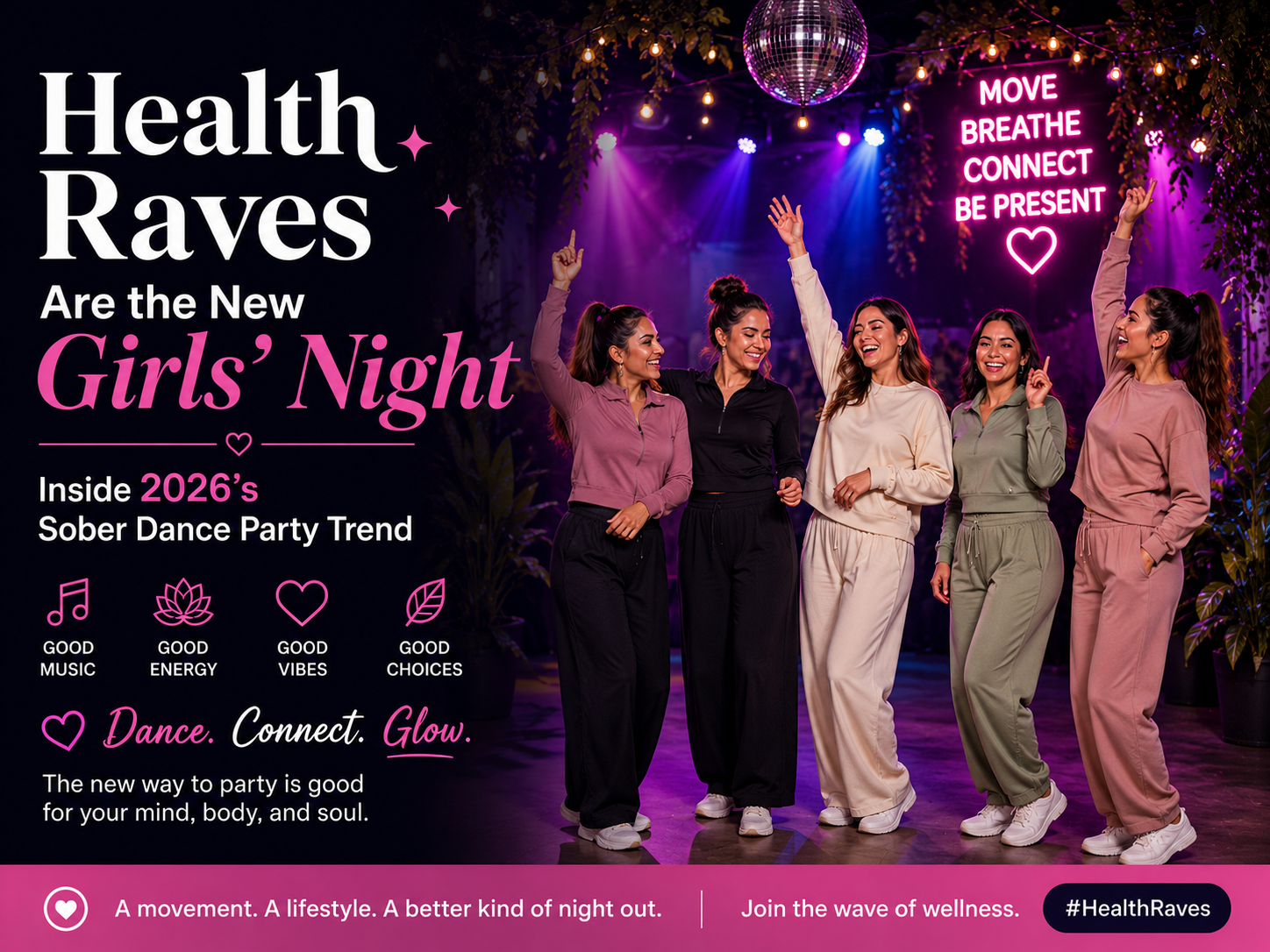
The lights come up at noon instead of midnight, the drinks are mocktails instead of well vodka, and by nine that night everyone is home, hydrated, and remembers the whole thing. Health raves, daytime and alcohol free dance parties built around movement, breathwork and community instead of bottle service, have quietly become one of the most talked about ways women are socializing in 2026. It sounds like a niche wellness fad until you look at the numbers behind it.
Quick Take
Nearly two in three Gen Z women plan to drink less this year, and sober bars are drawing serious daytime crowds. Health raves turn that shift into an actual night out, not a night in.
What a Health Rave Actually Is
A health rave looks like a regular dance party on the surface, a DJ, a crowd, colored lighting, a dance floor that fills up fast. The difference shows up at the bar, which serves mocktails, kombucha on tap or functional drinks built around adaptogens instead of alcohol. Many events open with a short guided breathwork or movement session before the music picks up, treating the dance floor less like a place to be seen and more like a place to actually move the body.
Events typically run in the afternoon or early evening rather than late night, which is part of the appeal. Nobody is planning around a hangover the next morning, and the entire structure of the day stays intact instead of being sacrificed to a 2 a.m. bedtime.
Why Sober Curious Culture Is Driving This
The sober curious movement among younger women has been building for a few years now, driven by a mix of health consciousness and a general rethinking of what a good night out is supposed to feel like. Almost two in three Gen Z women say they plan to drink less this year, and a meaningful share have never had a drink at all. Health raves are what happens when that shift stops being a personal choice made quietly at home and becomes something to actually do together, out loud, on a dance floor.
What makes the trend interesting is that it is not really about abstaining from anything. Most attendees are not in recovery and do not identify as sober in any clinical sense. They are simply choosing an environment where the point of the night is dancing and connection rather than drinking, and finding that the night works just as well, sometimes better, without the alcohol built into every part of it.
Inside the Experience
Walking into a health rave for the first time feels disorienting in a good way. The energy is unmistakably a party, loud music, a packed floor, people dressed to go out, but there is no line at a bar and no one nursing a drink in the corner. Everyone is just there for the dancing, which changes the entire texture of the room. Conversations start easier because nobody is performing sobriety or hiding a buzz, and the crowd tends to skew toward women showing up in groups rather than pairs, treating the whole thing as a version of intentional living applied to nightlife instead of mornings.
The physical payoff is real too. A two hour dance session is a genuine workout, and organizers increasingly lean into that, pairing events with the same energy people bring to home fitness setups and movement trackers, just with a DJ instead of an app cueing the next set.
How Health Raves Fit Into a Bigger Shift
Health raves did not appear out of nowhere. They sit alongside a broader move away from over scheduled, screen heavy socializing, the same instinct behind digital detox culture and the wider pullback from hustle era wellness. Community centered movement, dancing with strangers who become friends by the second chorus, is showing up as the antidote to a few years of solo workouts and solo scrolling.
Fitness tracking has followed the trend rather than led it. Many attendees now wear a smart fitness tracker to a health rave the same way they would to a spin class, logging heart rate and steps from a night out the same way they would log a workout, because increasingly, that is exactly what it is.
What to Expect at Your First One
Most health raves are ticketed the same way a regular event would be, through a venue’s site or a platform like Eventbrite, and prices generally sit close to a mid range concert ticket. Comfortable shoes matter more than an outfit here, since the whole draw is two or three hours of actual movement rather than standing around. Arriving solo is common and normal, since the format is built around meeting people on the floor rather than needing to bring a group in with you.
The morning after is the real selling point for a lot of first timers. No hangover, no fuzzy memory of the night, and often a pair of tired feet as the only real consequence, which is exactly the kind of trade a foot massager session the next day was made for, and a growing number of attendees treat that as part of the ritual rather than an afterthought.
Frequently Asked Questions
What is a health rave?
A health rave is an alcohol free dance party, usually held during the day or early evening, built around music, movement and mocktails instead of alcohol, often opening with a guided breathwork or warm up session.
Do you have to be sober to attend a health rave?
No. Most attendees are not in recovery and drink normally in other settings. Health raves are about choosing a specific kind of night out built around dancing and connection rather than requiring long term sobriety.
Are health raves just for Gen Z?
While Gen Z is driving much of the sober curious movement behind this trend, health raves draw a wide age range, since the appeal, real movement, real connection, no hangover, is not tied to any one generation.
Where can I find a health rave near me?
Health raves are increasingly listed on the same event platforms as regular concerts and club nights, and searching terms like sober rave or daytime dance party alongside your city name is usually the fastest way to find one.
The Bottom Line on Health Raves
Health raves work because they do not ask anyone to give anything up. The music is still loud, the dance floor still fills, and the night still feels like an event worth getting dressed up for. What disappears is the hangover, the 2 a.m. exhaustion and the sense that a good night out has to cost the next day to earn it. For a generation of women already rethinking what wellness looks like after dark, that trade is starting to feel like the obvious one.