

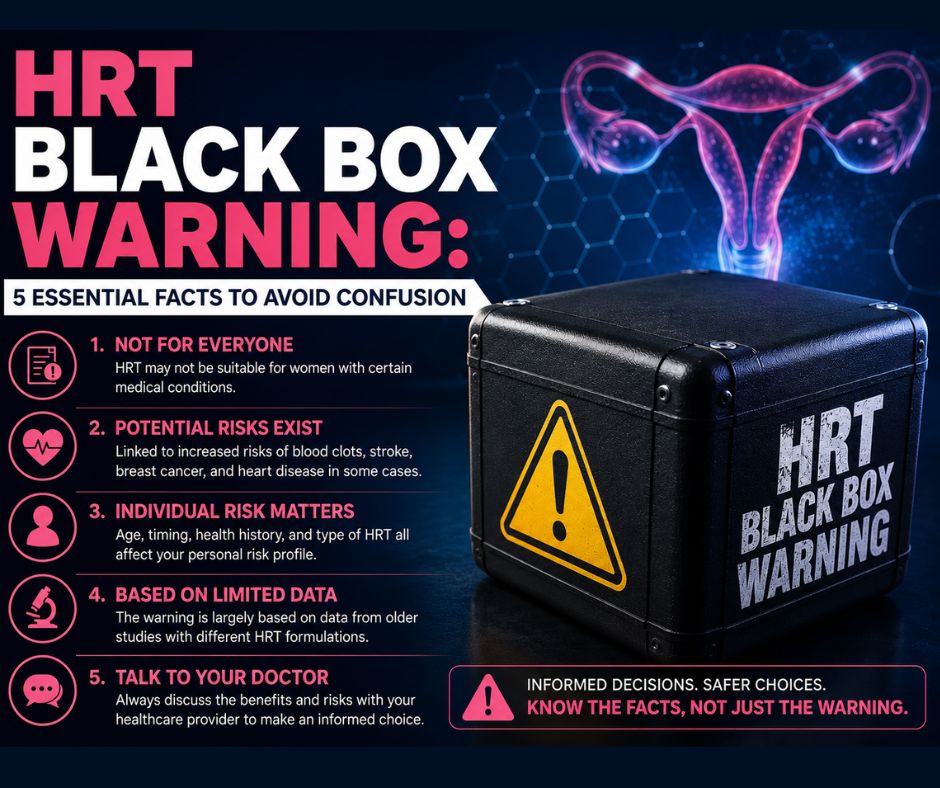
If you’ve seen headlines about hormone replacement therapy suddenly looking “safer,” you’re not imagining it. In February 2026, the FDA’s removal of the HRT black box warning went into effect reversing more than two decades of the strictest safety label the agency issues. It’s a genuinely big deal, but it’s also easy to misread as “hormone therapy is now risk-free for everyone,” which isn’t quite what happened.
Here’s a clear-headed breakdown of what actually changed, who it affects most, and what’s still worth discussing with your doctor.
1. What the Black Box Warning Actually Said
Since 2003, estrogen-containing menopause hormone therapy (MHT) products carried a black box warning — the FDA’s most serious safety alert — flagging increased risk of breast cancer, cardiovascular disease, and stroke. It applied broadly to systemic estrogen and estrogen-progestin combinations, and for over 20 years it shaped how doctors prescribed, and how women decided whether to even ask about, hormone therapy.
2. Why the FDA Removed It
The warning was based largely on the Women’s Health Initiative (WHI), a major study published in 2002. The catch: the WHI mostly enrolled women in their 60s, many starting hormone therapy more than a decade after menopause began a very different population from the 40 and 50 somethings managing hot flashes and sleep disruption today.
After a July 2025 FDA expert panel reviewing the evidence, the agency and HHS announced in November 2025 that black box warnings would be removed from four categories of hormone therapy products — estrogen-progesterone combinations, estrogen-alone therapy, progestogen-alone therapy, and topical vaginal estrogen. The change took effect in February 2026. FDA officials framed it as correcting two decades of applying one study’s findings, from one population, to everyone.
3. This Isn’t “Safe for Everyone Now”
This is the part worth sitting with. Removing a black box warning means the FDA no longer considers the risk severe and unqualified enough to warrant its strongest label it does not mean hormone therapy is risk-free.
Real, ongoing considerations doctors are still weighing:
- Timing matters most. The strongest evidence for benefit — and the best risk profile — applies to women who start hormone therapy within 10 years of menopause or before age 60.
- Residual risks remain. Venous thromboembolism (blood clots), ischemic stroke, and gallbladder disease are still on the table, particularly with oral estrogen. Transdermal (patch or gel) delivery appears to carry lower clot and stroke risk than pills.
- Uterus status changes the regimen. Women with a uterus still need a progestogen alongside estrogen to protect against endometrial hyperplasia and cancer risk — that part of the guidance hasn’t changed.
- It’s not one-size-fits-all. Personal or family history of breast cancer, cardiovascular disease, or blood clots still needs an individualized conversation with a provider, regardless of the label change.
Some clinicians have also raised questions about how quickly this particular label change moved through the review process compared to typical FDA procedure worth knowing as context, even though it doesn’t change the underlying science on timing and risk.
4. Why This Matters Even If You’re Not in Menopause Yet
If you’re in your 30s or early 40s, this might feel like a “future you” problem. It isn’t entirely. The label change reflects a broader shift in how menopause is being treated in medicine generally: less as something to quietly push through, and more as a window where protecting bone density, cardiovascular health, and cognitive function actually matters for decades afterward. Knowing this now means walking into a future conversation with your doctor already informed, instead of starting from scratch during a symptomatic, exhausting perimenopause.
5. What to Actually Do With This Information
You don’t need to make any decisions today. What’s worth doing:
- If you’re in perimenopause or menopause and symptoms are affecting your life, this is a good moment to bring hormone therapy up with your doctor if you haven’t already — the conversation is less encumbered by the old blanket warning than it used to be.
- Ask specifically about timing (how long since your last period, or your age), delivery method (oral vs. transdermal), and whether you have a uterus, since all three change the recommendation.
- If you have a personal or family history of breast cancer, blood clots, or cardiovascular disease, say so up front this is exactly the nuance the label change doesn’t erase.
FAQ
What was the HRT black box warning, and why did the FDA remove it?
It was the FDA’s strongest safety label, added in 2003 after the Women’s Health Initiative study linked hormone therapy to breast cancer, heart disease, and stroke. The FDA removed it in February 2026 after concluding the original warning overgeneralized findings from an older, higher-risk population to all women considering hormone therapy.
Does this mean hormone therapy is safe for everyone now?
No. It means the FDA no longer considers the risk severe enough for its strictest warning label for most healthy women, particularly those starting therapy within 10 years of menopause or before 60. Individual risk factors personal or family cancer history, clotting history, cardiovascular disease still matter and should be discussed with a provider.
If I have a uterus, do I still need progesterone with estrogen? Yes. That guidance hasn’t changed. Estrogen alone can overstimulate the uterine lining, so a progestogen is still added to protect against endometrial hyperplasia and cancer risk.
Does timing really make that big a difference?
Yes — it’s one of the most consistent findings in the research. Starting hormone therapy within about 10 years of menopause, or before age 60, is associated with the most favorable risk-benefit balance, including for cardiovascular and bone health. Starting much later shifts that balance.
This article is for general informational purposes and is not a substitute for personalized medical advice. Talk to your doctor or a menopause-informed healthcare provider about whether hormone therapy is right for you.